Introduction
Early-stage fundraising isn’t just about pitching – it’s about proving traction. Investors often say they invest in lines, not dots – meaning they want to see momentum. One of the best ways to demonstrate momentum is by building an effective sales funnel for customers and showing the metrics that result. A well-oiled sales funnel not only drives revenue and user growth, but it also creates the kind of numbers (recurring revenue, growth rates, retention, unit economics) that attract investors’ attention.
In this playbook, we’ll walk through how to craft a customer acquisition funnel that wows investors, treat fundraising itself as a funnel, and leverage real-world examples – from Dropbox’s viral referrals to Slack’s rapid adoption – to illustrate what great looks like.
Why a Strong Sales Funnel Matters for Fundraising
Think of your sales funnel as not just a revenue engine, but also as proof of product-market fit and growth potential. A healthy funnel demonstrates that you can attract, convert, and retain customers efficiently – exactly what early-stage investors want to see. Investors essentially look for signs that for every dollar you spend, you’re creating multiple dollars of value in return (hence the focus on metrics like LTV:CAC).
As a rule of thumb, SaaS startups are advised to maintain a Lifetime Value to Customer Acquisition Cost (LTV:CAC) ratio around 3:1 or higher. This implies you’re getting back at least $3 for every $1 spent acquiring a customer – a signal of sustainable growth. If your funnel is leaky or inefficient (say an LTV:CAC of 1:1), it’s a red flag that scaling up would burn cash without enough payoff.
Moreover, a well-structured funnel provides a repeatable growth process. Instead of sporadic sales, you have a clear pipeline from lead → customer → repeat customer. Investors love to see this because it suggests that injecting capital (for example, into sales and marketing) will predictably produce more customers and revenue – it’s not a black box.
Many seasoned founders treat fundraising itself like a funnel or pipeline, mirroring the sales process. You wouldn’t randomly contact customers and hope for the best; likewise, you shouldn’t wing it with reaching out to investors. A disciplined funnel approach to fundraising (researching targets, doing outreach, nurturing relationships, tracking progress) ensures no opportunity falls through the cracks.
Understanding the Customer Funnel (and What Investors See)
What is a customer funnel? It’s the step-by-step journey that potential customers go through, from first discovering your product to becoming loyal repeat users. Classic funnel stages include Awareness → Interest → Consideration → Purchase → Retention. You can visualize it as an inverted pyramid (wide at the top and narrowing down at each stage).
For example, imagine 1,000 people become aware of your product (through ads, content, word-of-mouth), 200 show interest and sign up for a free trial, 50 decide the product is worth paying for, and 40 remain long-term paying customers. This funnel diagram (with numbers shrinking at each stage) helps you pinpoint where you’re losing people and where to focus improvements.
Founders should track conversion metrics at each stage of their funnel. Why? Because investors will ask about them. If 1,000 website visitors convert into 50 paying users, that’s a 5% visitor-to-customer conversion rate – is that good? For context, an average landing page might only convert ~2-3% of visitors, while top-performing SaaS companies achieve 10%+ conversion from visitor to sign-up. Activation (the point at which a user experiences core product value) is another key funnel metric – the average activation rate across SaaS businesses is ~37.5%, meaning about one-third of sign-ups take the actions that indicate they’re “active” users.
As a founder, improving these metrics not only drives revenue but tells a story: users want and value our product. That’s exactly the story you want investors to hear.
Top of Funnel (Awareness & Acquisition)
This is how you attract leads. It could be content marketing, social media, referrals, or paid ads. Key metrics include website traffic, click-through rates, and visitor-to-signup conversion.
Investor lens: Efficient acquisition is gold. If you’re acquiring users cheaply or organically (e.g. via viral referrals or word-of-mouth), that’s a huge plus because it suggests a low CAC and product-led growth. For example, Dropbox’s referral program is legendary for top-of-funnel growth – it turned customers into a viral acquisition channel. By offering free storage for referrals, Dropbox grew from 100,000 to 4,000,000 users in just 15 months, an astounding 3900% growth with minimal marketing spend. When investors saw such explosive organic growth, they took notice – it was proof of a product that basically “sold itself.”
Middle of Funnel (Interest & Consideration)
Here, leads are evaluating your product. They might be in a free trial or using a free tier, engaging with content, or in a demo call for B2B. Metrics here include trial-to-paid conversion rate, time-to-value (how quickly users get value), and engagement during the trial.
Investor lens: This stage indicates product-market fit. If a high percentage of trial users convert to paid (or a high % of freemium users become active), it signals that users genuinely find value and are willing to pay. For instance, Slack’s strategy of letting teams use a free version led to massive adoption through the funnel’s middle – people tried it, loved it, and then advocated for it at work. Slack garnered 8,000 sign-ups in 24 hours and 15,000 users within 2 weeks of launch without a big marketing push. One year later (after widespread team trials), they had 285k daily active users and by the next year over 1 million DAUs – a clear indicator to investors that Slack’s free-to-paid funnel was converting teams into long-term users at an incredible rate.
Bottom of Funnel (Conversion & Retention)
This is where the lead becomes a paying customer, and ideally a happy one who sticks around. Key metrics: conversion rate from lead to paid customer, monthly recurring revenue (MRR) growth, churn rate, and retention or expansion revenue.
Investors love retention and efficiency here. Strong retention means low churn, which directly impacts lifetime value. Take the design tool Figma as an example – by focusing on collaborative features and community, Figma achieved 96% gross revenue retention and 132% net dollar retention (meaning existing customers were expanding their spend). Such retention metrics are best-in-class and essentially tell an investor “customers not only stay, they spend more over time” – the hallmark of a scalable SaaS business.
Another bottom-funnel metric is the LTV:CAC ratio mentioned earlier. If you’re efficiently turning leads into long-term customers (with, say, LTV:CAC > 3), it signals that pouring more fuel (money) on the fire will likely lead to even more growth. On the flip side, if your churn is high or payback period on CAC is too long, investors will worry that you haven’t yet figured out how to retain customers profitably.
What Customers Care About vs. What Investors Look For
Your job as a founder is to serve customers and to communicate your success to investors. It helps to know the differences and overlaps in these perspectives. Here’s a quick comparison:
| Aspect | Your Customer’s Priority | Investor’s Priority |
| Problem Solving | A solution to their immediate problem; ease of use and clear value for them personally. | Validation that this problem is widespread (big market) and your solution addresses it uniquely (scalable market fit). |
| Value Proposition | Getting a great product at a fair price – ROI for their money or time. | Unit economics and pricing that yield high margins and lifetime value; potential for price increases or upsells (revenue expansion). |
| Trust & Credibility | Reliable service, good support, social proof from reviews or referrals. | A credible founding team and traction proof points (users, revenue) that de-risk the investment; any endorsements or big-name customers help. |
| Growth & Engagement | New features, improvements, and a product that keeps them engaged (they care about their experience). | Growth metrics: month-over-month user growth, engagement rates, low churn. (Happy customers translate into the graphs “up and to the right.”) |
| Long-Term Satisfaction | That the product continues to solve their needs and improve over time (so they stick around). | Retention and lifetime value – evidence that customers stick around for years, indicating a sticky product and potential for large LTV. |
As you can see, delighting your customers feeds directly into what impresses investors. If you focus on making customers happy (solving a real problem, providing great value, retaining them), you will naturally generate the numbers that investors focus on (growth, revenue, retention, etc.).
A practical takeaway: Translate customer success into metrics/terms that matter to investors. If you have testimonials (qualitative proof), pair them with data (quantitative proof). For example: “Customers say our fintech app saves them hours each week – and our retention shows it: 80% of users are still active after 6 months.” This connects the dots between user love and investor ROI.
Step-by-Step: Building a Customer Funnel that Scales
Let’s outline a simple step-by-step process to build and optimize your sales funnel. This is your game plan for acquiring and converting customers systematically:
1. Identify Your Target Customer and Value Hook
Start by clearly defining your ideal customer profile – who are they, what do they need, where do they hang out? Then craft a compelling value proposition that will catch their attention. This often becomes your “hook” at the top of the funnel. (Example: A SaaS offering AI-driven copywriting might hook customers with “Write blog posts 10x faster with one click.”)
2. Attract Leads (Top-of-Funnel)
Drive awareness through channels your target customers use. Common tactics include content marketing (SEO-driven blogs, whitepapers), social media, participating in communities, offering a free tool or a lead magnet, and referral programs. The goal is to fill the funnel with qualified prospects. Keep an eye on Cost of Acquisition per channel.
Case in Point: When fintech startup PayPal struggled to gain users via ads, they shifted to a referral incentive – paying people to join and refer friends. This “give $10, get $10” referral program sparked 7–10% daily user growth, skyrocketing PayPal from 1 million to 5 million users within months. It was expensive, but it bought them viral growth that impressed investors (and ultimately helped them dominate online payments).
3. Engage and Nurture (Mid-Funnel)
Once you have leads (site visitors, sign-ups, etc.), don’t let them slip away. Use email newsletters, webinars, free trials, and personalized onboarding to nurture interest. The objective here is to educate the prospect and prove your product’s value. Track metrics like email open/click rates, trial usage frequency, or feature activation rates.
If you notice, for example, that users who take X action in the first week are far more likely to convert to paid, double down on guiding every user to that “aha moment.” Slack’s playbook: they made sure new teams quickly experienced how easy it was to communicate on Slack. By the time Slack went from preview to public launch, that nurturing had already turned hundreds of thousands of users into daily active addicts.
4. Convert (Bottom-Funnel)
Here is where leads become paying customers. Make the conversion process as smooth as possible – simplify pricing, offer limited-time promotions, provide social proof (case studies, testimonials), and reduce friction (easy sign-up, credit card trials, etc.). Sales-oriented startups might use demos and proposals; product-led startups might rely on in-app upgrade prompts.
Monitor your conversion rate and experiment with improvements. This is also where your Monthly Recurring Revenue (MRR) starts to grow. As a rough benchmark, SaaS startups often aim for a certain MRR by stage – e.g. reaching $20K–$50K MRR by Seed stage is common in many industries. Hitting solid revenue milestones shows investors that customers are indeed willing to pay for your solution at scale.
5. Deliver & Retain (Post-Sale)
The funnel doesn’t end at the sale – arguably, the most important part is retaining the customer and increasing their lifetime value. Ensure great onboarding, customer support, and continue delivering on your value promise. Engage customers with new features and by building community or habits around your product.
A retained customer might refer others (feeding back into the top of the funnel) or expand their account. High retention and low churn are huge positives for fundraising. Remember, investors love to see “land and expand” models where initial users lead to more usage or seats over time (as seen with Figma or Slack’s team-based growth). If you can show that net retention is above 100% (meaning expansion revenue outweighs churn, as in Figma’s case), your funnel isn’t just bringing in customers – it’s compounding their value, which is investor nirvana.
6. Measure, Iterate, and Optimize
Constantly track your funnel metrics and identify weak spots. If lots of people visit your site but few sign up, tweak your messaging or target audience. If many start a trial but don’t convert, examine your onboarding or pricing. Use cohort analysis to see how retention is improving as you iterate.
This data-driven refinement not only grows your business faster but also demonstrates to investors that you have a handle on your growth levers. Founders who know their numbers and continuously improve them give off the vibe of “future CEO who will skillfully deploy my investment” – exactly the confidence you want to inspire.
Building an Investor Funnel (Your Fundraising Pipeline)
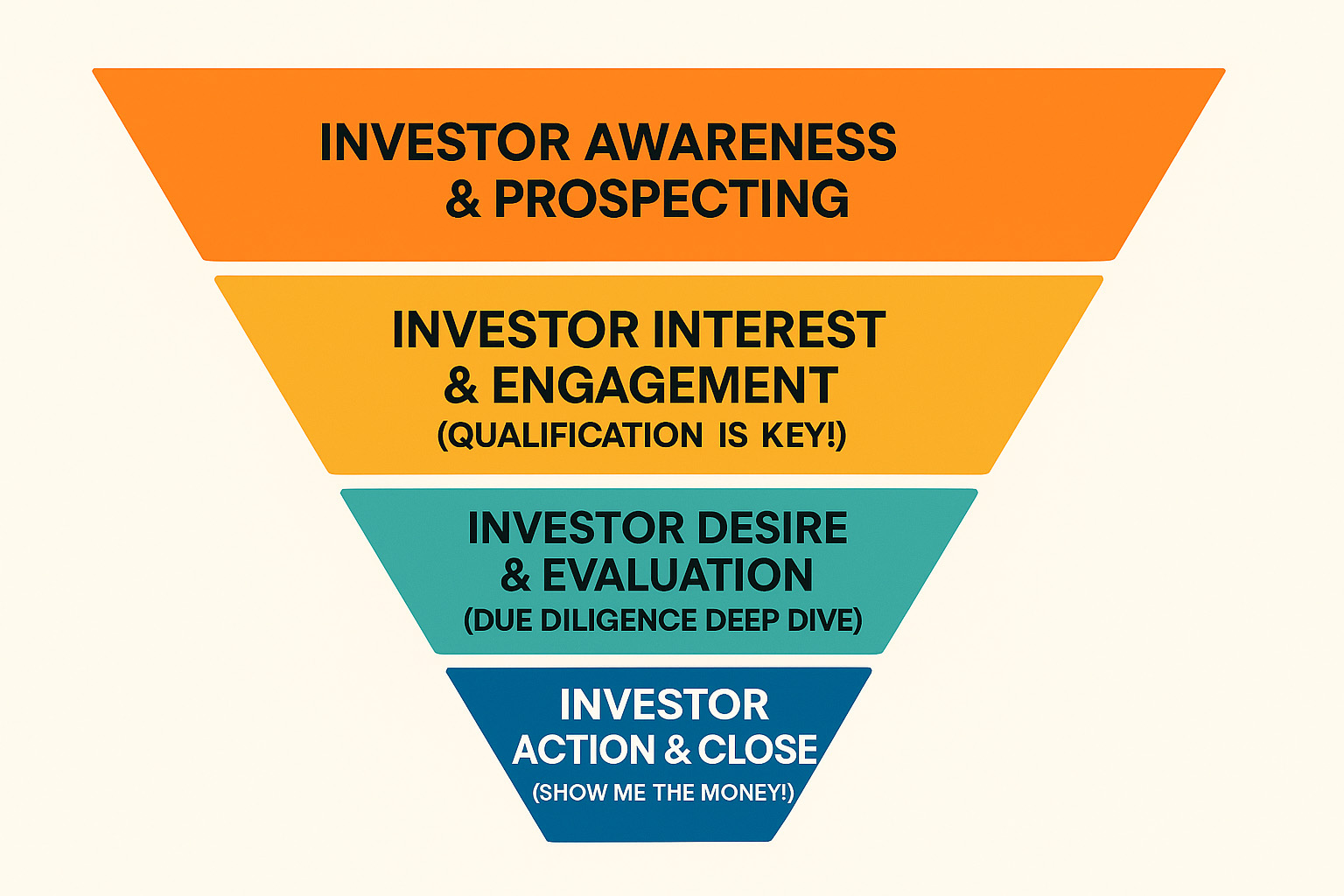
Just as you have a customer funnel, you should construct an investor funnel when fundraising. This means treating potential investors like leads that you will methodically filter and convert. Why? Because fundraising is fundamentally a numbers game mixed with relationship-building. Even great startups often hear dozens of “no” answers before a “yes.” By organizing the process into a funnel or pipeline, you ensure you’re reaching out broadly and managing the flow, rather than pinning all hopes on one or two VCs.
Stages of an Investor Funnel
You can imagine an investor funnel with stages like Targeting → Introduction → Pitch Meeting → Due Diligence → Term Sheet/Closing. For example, you might start with a list of 50–100 target investors (the top of funnel). Through networking and outreach, perhaps 30 of those express some interest and take an intro meeting. Of those, maybe 10 go deeper, asking for your deck and data room (due diligence). In the end, you might get 1–3 term sheets (offers).
That’s a pretty typical funnel ratio for a seed round – it narrows significantly at each stage. Knowing this, you won’t be discouraged when the majority drop out early; it’s expected. The key is to keep enough volume at the top and skillfully nurture investors through the funnel.
Practical Steps to Build Your Investor Pipeline:
1. Create a Target List:
List out potential investors who are a good fit (consider their focus: industry, stage, check size, geography). This list could include angel investors, seed funds, venture capital firms, and even non-traditional backers (like crowdfunding or syndicates) depending on your approach. Aim high but be realistic; include some “reach” VCs but also smaller investors who regularly do seed deals in your domain.
2. Warm Up and Introductions:
Just like marketing to customers, cold outreach can work but warm introductions work better. Leverage your network (advisors, other founders, mentors, LinkedIn) to get introduced to people on your target list. When that’s not possible, a well-crafted cold email can still be effective – personalize it and make it concise about why your startup is exciting (mention key traction like growth rate or customers, analogous to a teaser of your funnel metrics).
3. Pitch and Follow-Up:
As investors move to the next stage (showing interest), you’ll pitch them – via a deck presentation or a demo. Treat these like you would a sales call: listen to their questions (understand their needs/concerns), and tailor your messaging accordingly. After a meeting, always follow up with any materials they requested and a thank-you note. Just as you might send a trial user more info to help them convert, send interested investors updates that keep them engaged.
4. Manage the Funnel Actively:
Use a simple CRM or spreadsheet to track where each investor is in your funnel (contacted, meeting scheduled, due diligence, etc.). This helps you visualize your pipeline just like a sales funnel. It ensures you’re not dropping the ball on anyone – e.g., forgetting to send your deck to someone who asked for it. It also lets you gauge your conversion rates (how many intros lead to meetings, etc.) and adjust if needed.
5. Leverage Momentum:
Just as customers exhibit herd behavior (social proof), investors do too. If you get a reputable lead investor or even a verbal commitment, use that momentum to encourage others along. It’s akin to highlighting big customer logos to close new sales. Create a bit of FOMO – e.g., “We’re targeting a close by end of next month; already have interest covering half the round.” But be truthful; credibility is crucial.
6. Close the Deal:
The bottom of the investor funnel is receiving term sheets and ultimately money in the bank. At this stage, focus on converting interest into commitment. Be responsive in due diligence (have your financials, metrics, and references ready to go), and negotiate terms that work for you but also respect the investor’s requirements.
Case Studies: Funnels in Action (and Investor Reactions)
Let’s look at a few real-world examples of how an effective funnel translated into investor interest and funding. These case studies span SaaS, fintech, AI, and marketplace startups – showing that the principles apply universally, even if the tactics differ.
⭐Dropbox: Viral Referral Funnel Fueling Rapid User Growth
Dropbox is a textbook example of using a product-driven referral funnel to achieve explosive growth. In Dropbox’s early days (around 2008–2010), instead of spending big on ads, they built a referral program into their product: when a user invited a friend and that friend signed up, both got bonus storage space. This simple mechanism tapped into users’ networks and incentivized them to spread the word.
The results were astounding – Dropbox went from about 100,000 users to 4,000,000 users in 15 months, doubling users roughly every three months at its peak. That’s a 39x increase (3900% growth) in just over a year! Even more impressively, they achieved this with very little paid marketing spend – the users became the marketing engine.
For investors, these numbers were highly compelling. Such rapid adoption indicated a massive market demand and an extremely efficient funnel (their Customer Acquisition Cost was trivial in this model, essentially the cost of some storage space). The user retention was also strong – people who got Dropbox tended to keep using it (since files and collaboration were involved, it became sticky).
⭐Slack: Bottom-Up SaaS Adoption and Lightning-Fast Traction
Slack’s rise is another remarkable funnel story, especially for B2B SaaS. Slack didn’t use a traditional enterprise sales funnel at first – instead, they employed a bottom-up, product-led growth funnel. The idea was simple: let teams use Slack for free and fall in love with it, and leverage that grassroots adoption to spread within organizations.
In its very first weeks, Slack’s funnel metrics were off the charts: 8,000 people signed up on day one, and 15,000 by the second week – all this before any formal marketing. How did they achieve it? Largely through word-of-mouth and a great product experience. By the time Slack officially launched to the public (after a lengthy preview period), they had 285,000 daily active users – an extraordinary level of traction for an enterprise collaboration tool in such a short time. One year later, that number hit over 1 million DAUs.
Investors watching Slack saw a few key things: a very low CAC (people were finding Slack largely on their own or via invites), a high conversion from free to active (the product was sticky and viral), and a huge market (practically every knowledge worker could be a user). No wonder Slack secured a $1.2 billion valuation just 8 months after launch and kept raising from top VCs – the funnel metrics spoke for themselves.
⭐PayPal: Fintech Growth Hacking with LTV in Mind
Not all funnels are purely product-driven; some, like PayPal’s, used savvy marketing economics to kickstart growth. In the late 1990s, PayPal was a fintech trying to solve online payments. They faced a classic two-sided market dilemma (needed buyers and sellers) and trust issues with a new service. Traditional ads weren’t cutting it, so they engineered a funnel hack: pay people to join and refer.
PayPal gave new users $10 for signing up, and another $10 for each referral – a bold move that essentially turned their marketing budget directly into user acquisition bounties. This cost them millions, but the effect was dramatic: at one point PayPal was growing 7–10% per day in user count. They went from about 1 million users to 5 million in just a few months, and eventually to over 100 million users via this viral loop.
The genius was that the lifetime value (LTV) of a PayPal user – especially as eBay merchants adopted it – could justify that upfront cost. Once PayPal became the default payment method on eBay, those users generated transaction fees over and over. In other words, PayPal understood their LTV well enough to basically buy growth while still making the economics work long-term.
⭐Jasper (AI SaaS): Hyper-Growth by Riding the AI Wave
To include a more recent example, let’s consider Jasper, an AI-powered copywriting SaaS, which shows how a strong funnel combined with a hot market trend can accelerate fundraising. Jasper launched in 2021 leveraging OpenAI’s GPT-3 technology to help companies and marketers write content faster. They employed a product-led funnel: offering trials, a self-service sign-up, and a ton of educational content to show use cases.
The demand turned out to be enormous. Jasper’s funnel from trial → paid was highly optimized (marketers who saw it “write” copy for them often converted quickly), and the company drove awareness through affiliate marketing and a vibrant community of users sharing success stories. In less than a year, Jasper reportedly grew to $35 million in ARR (Annual Recurring Revenue) – with a team of only 9 people – an almost unheard-of pace. They acquired over 50,000 paying customers in that time, indicating a scalable funnel where they could pour in marketing (they ramped up from $50k to $1M/month in ad spend profitably) and get lots of paying users out.
When Jasper went out to raise capital, investors were eager; the company raised a $125 million Series A at a $1.5 billion valuation not long after that first year of growth. The metrics did the talking: ~30% monthly growth, strong revenue retention (many customers on annual plans or expanding usage), and a huge market appetite for AI tools.
⭐Uber: Multi-Sided Funnel and “Free Trials” for a Marketplace
Finally, to illustrate a marketplace model, let’s briefly discuss Uber. Uber’s “funnel” is multi-sided (riders and drivers), but one of their clever growth tactics was treating the first ride as a free trial to reduce friction for new users. Uber frequently offered $20 credits for a new rider’s first trip, essentially giving everyone a no-risk way to experience the product. This tactic, along with referral codes for free rides, removed the barrier that might make someone think “Do I really want to pay for this unknown service?”
Once people tried Uber, they often loved it (“press a button and in 5 minutes a car appears!”) and became repeat users. In funnel terms, Uber had an excellent conversion from trial to repeat because the experience was such an improvement over traditional taxis. They also grew largely by word-of-mouth – CEO Travis Kalanick noted that 95% of riders heard about Uber from other riders in the early days. That’s an almost self-propelled funnel: one rider’s delight brings in another rider.
Investors saw Uber’s user growth and ride volume skyrocket in each city once these tactics took hold, giving confidence to pour in funding for rapid expansion. Uber’s fundraising rounds were huge, but they were justified by a growth curve that looked more like a steep staircase (city by city).
For founders of marketplace startups, Uber’s story underscores the value of reducing friction for initial use (even if it costs you) and leveraging both sides of the market to feed growth (happy riders attract drivers, and vice versa). When pitching investors on a marketplace, demonstrating that you’ve engineered liquidity (enough supply and demand) in a local funnel is key.
How Tech Trends Are Changing the Fundraising Funnel
No playbook in 2025 would be complete without addressing how new technology trends are reshaping the way founders build funnels and raise capital. Three big ones to note are AI, blockchain, and new funding models:
AI-Powered Growth & Outreach
AI is impacting both how you grow your customers and how you approach investors. On the customer side, AI tools can help analyze funnel data to find drop-off points or predict which leads are most likely to convert, allowing you to focus efforts intelligently. AI-driven personalization (e.g. using AI to tailor email or in-app messages) can boost conversion rates by engaging users with more relevant content.
On the fundraising side, founders are starting to use AI for tasks like finding investors (there are tools that scrape databases to suggest VCs who invest in your space), or even to draft and refine pitch materials. While human connection is still paramount in fundraising, AI can save time – think of it as augmenting your funnel management by quickly researching what an investor cares about so you can tailor your pitch.
Additionally, the sheer excitement around AI startups can accelerate funnels – as we saw with Jasper’s rapid rise, being in a hot AI space can mean investors come knocking on your door as much as you reaching out to them. That said, be prepared to answer hard questions if you’re an AI startup: savvy investors will still probe for retention and real usage beyond the hype.
Blockchain and Decentralized Funding (STOs/ICOs)
Blockchain technology has opened up new ways to raise money and build communities, often blurring the line between customers and investors. In the late 2010s we saw the rise of Initial Coin Offerings (ICOs) – basically crowdfunding via tokens – and more recently regulated versions like Security Token Offerings (STOs). These are fundamentally new fundraising funnels. Instead of pitching a small set of VCs, startups (especially in crypto) could pitch a global pool of enthusiasts who buy tokens.
This means your “investor funnel” could actually be thousands of people who believe in your product’s vision, not just a dozen venture firms. It’s a different dynamic: marketing and community-building take center stage. Investors (token buyers) care about the project’s potential adoption and the token’s utility or value, which often ties directly to user metrics. In effect, your customer and investor funnels merge – early users become investors via tokens.
Blockchain-enabled fundraising methods like ICOs and STOs are broadening the scope of startup financing, allowing companies to raise capital from a wider audience of backers. For founders, if you go this route, transparency and hype management are crucial – you’re accountable to a community from day one. On the flip side, the advantage is that a passionate community that holds a stake (tokens) in your success can turn into an army of advocates, driving customer acquisition in a decentralized way.
New Fundraising Models (Crowdfunding, Revenue-Based Financing, etc.)
Beyond VC and token sales, there are now platforms for equity crowdfunding (e.g., Republic, SeedInvest) where many individual investors can fund your startup in exchange for equity or perks. This can be a viable funnel especially for B2C startups with an easily understandable mission – you’re essentially marketing your investment opportunity like a product to potential backers.
Another model is revenue-based financing or venture debt for those with revenue: companies like Clearco or Pipe let you raise money against future revenues. This isn’t “investor” money in the traditional sense (more like non-dilutive capital), but it changes your funnel by possibly delaying the need for VC and giving you more runway to grow. Founders should be aware of these options because they can complement or alleviate the equity fundraising process.
The landscape of funding is richer now – and sometimes investors themselves view a diverse funding strategy as a positive sign (it shows you’re savvy about cost of capital). In summary, technology is enabling founders to get creative with both customer growth and fundraising. An investor in 2025 might ask you how you’re leveraging AI in your go-to-market, or whether community token holders are part of your strategy, or how you plan to crowdfund early adopters.
Conclusion: Turning Funnels into Funding
For an early-stage founder, building an effective sales funnel isn’t just a marketing exercise – it’s one of your strongest weapons in the quest for funding. By focusing on customer success and metrics, you create a virtuous cycle: happy customers generate impressive numbers, which attract investors, whose capital then helps you get more happy customers, and so on.
We’ve discussed how to map out your customer’s journey from awareness to retention, how to align what you measure with what investors want to see, and why treating fundraising like a funnel can keep you sane (and systematic) in the chaotic process of raising capital.
Key Takeaways:
- Know and Grow Your Numbers: Track metrics like conversion rates, MRR, growth %, LTV:CAC, and retention religiously. Use industry benchmarks (e.g., aim for LTV:CAC > 3, or seed-stage MRR in the tens of thousands, or MoM growth of 15%+ at early stages) as goalposts. These give you concrete targets to strive for and talk about. When you can say “Our CAC is $50 and LTV is $500 (10x difference)” or “We grew 25% last month and 20% the month before,” you’re speaking an investor’s language – traction.
- Storytelling with Examples: Don’t hesitate to weave in analogies or case studies when pitching. “We’re the Slack for X” immediately conveys a bottom-up adoption strategy to an investor. Or “We have a Dropbox-like referral component” signals potential virality. In your deck or conversations, highlighting a mini case study of your own progress can mirror the famous examples and make your startup feel like the next big story. Just ensure the comparisons are credible and the numbers back them up.
- Focus on Efficiency Early: While growth is king, the early-stage funding environment in 2025 cares about efficient growth. Gone are the days (mostly) of “grow at all costs, worry about monetization later.” If you can show that your funnel is not only getting bigger (more users) but also tighter (higher conversion, improving payback time), you’ll stand out. High burn with no handle on unit economics might scare off investors unless you have truly exceptional growth.
- Leverage New Avenues Prudently: If considering an ICO/STO or crowdfunding, integrate it into your overall strategy rather than chasing it for easy money. The best examples of these are when a company genuinely benefits from having a community of investor-users. Similarly, use AI not because it’s a buzzword, but because it can reduce your customer acquisition costs or personalize your product – tangible benefits that improve your funnel.
- Case Stories Inspire, but Your Story Is Key: We saw how Dropbox, Slack, PayPal, Jasper, Uber achieved something special with their funnels. Use them as inspiration and proof that creative thinking pays off. However, remember that your startup’s funnel story is what you need to hone. Maybe you won’t get 3900% growth in a year, but perhaps you’ll achieve a smaller-scale miracle in your niche – like a marketplace that, through hyper-local focus, achieved 50% month-over-month growth in one city, or a SaaS that upsold 40% of its customers to annual plans, or a fintech app that reached a $100K revenue run-rate purely via TikTok videos. Celebrate those wins and then systematize them.
Ultimately, building an investor-attractive sales funnel comes down to focusing on customers first. If you genuinely solve a problem and make users happy, you’ll generate the kind of traction that smart investors can’t ignore. Marry that with a disciplined approach to fundraising (your investor funnel), and you’ll maximize your chances of not only getting funded, but getting funded on your terms.
Good luck, and may your funnels be ever-flowing – with new customers at the top and delighted advocates (and steady revenue) at the bottom, paving the way for the investment that will take you to the next level.